Building your own escape room starts with good ideas. Here are thirty puzzles, clues and twists made from things you already own, grouped by type, plus story ideas to tie them together.
The best escape room ideas are simple: a clue that makes players look at an ordinary object in a new way. Every idea below can be made with household items, a printer and one or two cheap locks. Pick six to eight, link them into a chain and you have a game. Our step-by-step guide on how to make an escape room at home shows how to put it all together.
Search and hiding ideas
- Book safe: hide a key inside a hollowed-out book, or simply between the pages of one book on a full shelf.
- Frozen clue: freeze a key or a rolled note in an ice cube. Players must find a way to melt it.
- Under the label: write a number on the inside of a jar label or bottle label.
- Pocket trail: hide clues in the pockets of coats hanging by the door.
- Taped under furniture: a classic for the first clue, because everyone forgets to look underneath.
- Inside a balloon: players must pop the right balloon (the one with a dot).
Number and code ideas
- Clock code: set four clocks or watches to different times; the hour hands give a four-digit code.
- Color count: four colored dots on a lock; count objects of each color in the room.
- Calendar circles: circle dates on a calendar; the dates in month order give the code.
- Phone keypad: a word converts to numbers on a phone keypad (CODE = 2633).
- Book coordinates: "page 12, line 3, word 2" leads to a word for a letter lock.
- Dominoes or dice: arranged dice in a photo show the digits of a code.
Cipher and message ideas
- Letter shift: every letter moved three places along the alphabet; hide a decoder wheel.
- Number alphabet: 1 = A, 2 = B; simple for kids.
- Invisible ink: a UV pen message on a white wall card, with the UV torch hidden elsewhere.
- Lemon juice ink: a message that appears when an adult warms the paper. Supervise any heat.
- Mirror writing: a note that only reads correctly in a mirror, with a mirror in the room.
- First letters: the first letters of each line of a poem spell the answer.
- Morse code: dots and dashes on a necklace of long and short beads.
Physical and hands-on ideas
- Jigsaw with a code: write a code on a photo, cut it into pieces and hide them.
- Magnet fishing: a key at the bottom of a tall vase, reachable only with a magnet on a string.
- Laser maze: red yarn across a hallway; players crawl through without touching it to reach the next clue.
- Puzzle box: a box held shut with several rubber bands, each band with a tag that needs an answer.
- Scale balance: weigh objects to find the heaviest; the clue is under it.
- Glow in the dark: turn off the lights and a painted code appears on the ceiling.
Team and twist ideas
- Split information: half a map in one room, half in another; players must talk to combine them.
- Red herring: one fake clue that leads nowhere. Use sparingly and only for adults.
- Audio clue: a voice memo on an old phone gives the next instruction.
- Photo match: a photo of a corner of the room; players must find where it was taken.
- Final meta-puzzle: each solved puzzle gives one letter; together they spell the last password.
Story ideas to tie it together
| Story | Goal | Good for |
|---|---|---|
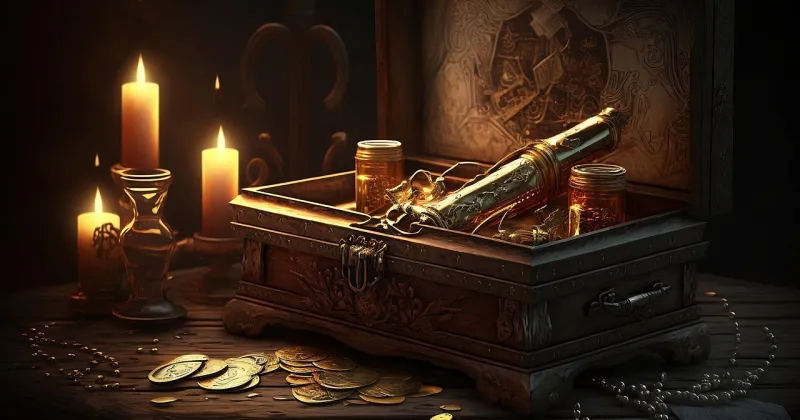
| Pirate treasure | Open the treasure chest | Kids' parties |
| Mad scientist's lab | Find the antidote before the timer ends | Teens, adults |
| Museum heist | Steal back the stolen jewel | Mixed groups |
| Detective case | Name the culprit | Adults, dinner parties |
| Wizard school | Recover the spellbook | Kids, families |
| Holiday rescue | Save the presents | Christmas, birthdays |
For more on choosing a setting, see our guide to escape room themes.
How to chain the ideas
Plan from the end. Decide what the final lock is, then pick the idea that produces its code, then the idea that leads to that clue, and so on back to the start. Mix types so everyone gets something they enjoy: a search, a code, something physical, something to read. Then test the chain once with a friend before the game. For the puzzle types commercial rooms use, see our list of escape room puzzles.
Questions
How many puzzles do I need for a DIY escape room?
Five to eight for a 45-minute adult game, three to five for young children. A chain that is too long becomes tiring at home.
What is an easy escape room idea for beginners?
Hide four numbered cards around the room and lock the final box with a four-digit lock. Add a clue that says which order to read them in.
Can I make escape room puzzles without locks?
Yes. Use sealed envelopes that players can only open when they say the correct answer to you.
What are good clue ideas for kids?
Picture clues, counting objects, simple number-to-letter codes and treasure-hunt style "look under the..." notes.