Every letter, number and common punctuation mark in International Morse code, with the timing rules and the patterns that make the chart easier to remember.
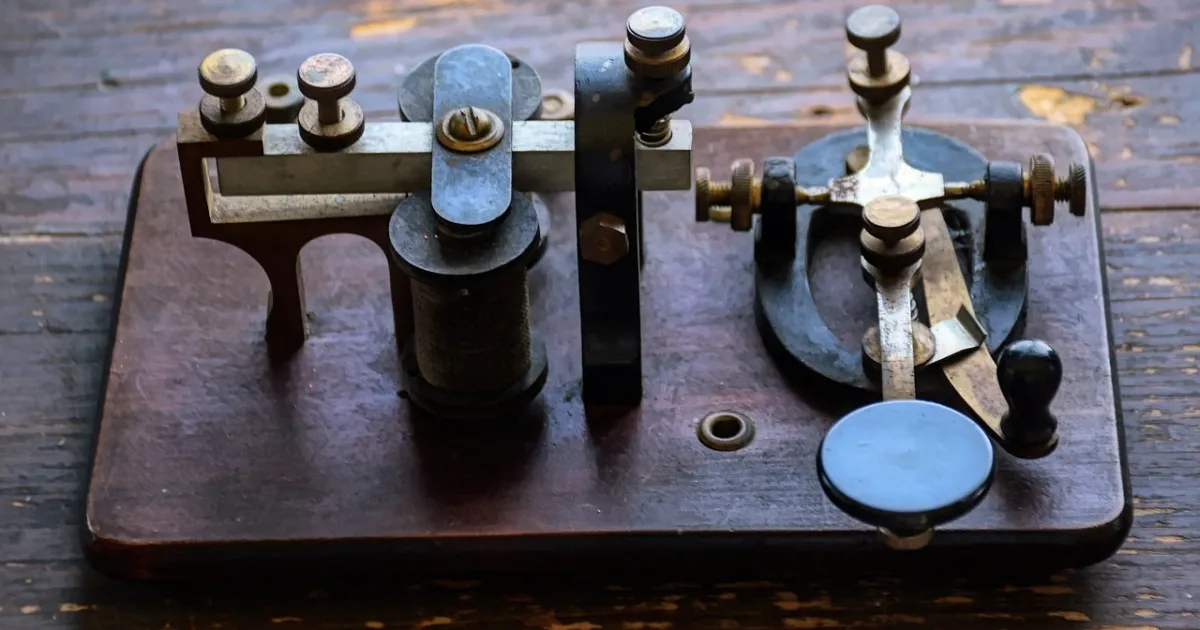
The Morse code alphabet turns each letter into a short pattern of dots and dashes. A is dot dash (.-), B is dash dot dot dot (-...), and E, the shortest of all, is a single dot. The charts below give the 26 letters, the numbers 0 to 9 and the common punctuation marks as they stand in the international standard, Recommendation ITU-R M.1677-1, which the International Telecommunication Union approved in October 2009.
A dot is one short signal and a dash is one long signal. In the tables a period stands for a dot and a hyphen for a dash, so .-.. reads "dot dash dot dot".
Morse code chart: letters A to Z
| Letter | Code | Letter | Code |
|---|---|---|---|
| A | .- | N | -. |
| B | -... | O | --- |
| C | -.-. | P | .--. |
| D | -.. | Q | --.- |
| E | . | R | .-. |
| F | ..-. | S | ... |
| G | --. | T | - |
| H | .... | U | ..- |
| I | .. | V | ...- |
| J | .--- | W | .-- |
| K | -.- | X | -..- |
| L | .-.. | Y | -.-- |
| M | -- | Z | --.. |
The standard has no separate codes for capital and small letters. It lists one accented letter, é, which is ..-.. (dot dot dash dot dot).
Morse code numbers
Every numeral takes exactly five signals, and the ten codes follow one pattern. From 1 to 5 the code starts with that many dots and is filled up to five with dashes. From 6 to 9 it starts with dashes, one for 6 and four for 9, and is filled up with dots. Zero is five dashes.
| Number | Code | Number | Code |
|---|---|---|---|
| 1 | .---- | 6 | -.... |
| 2 | ..--- | 7 | --... |
| 3 | ...-- | 8 | ---.. |
| 4 | ....- | 9 | ----. |
| 5 | ..... | 0 | ----- |
Punctuation and procedure signals
Punctuation runs longer than letters: each mark takes five or six signals. The last six rows of this table are instructions to the other operator, not text.
| Sign or signal | Code |
|---|---|
| Period . | .-.-.- |
| Comma , | --..-- |
| Colon : | ---... |
| Question mark ? | ..--.. |
| Apostrophe ' | .----. |
| Hyphen - | -....- |
| Slash / | -..-. |
| Opening parenthesis ( | -.--. |
| Closing parenthesis ) | -.--.- |
| Quotation marks " | .-..-. |
| Double hyphen = | -...- |
| Plus sign +, also the cross that ends a message | .-.-. |
| At sign @ | .--.-. |
| Understood | ...-. |
| Error | ........ |
| Wait | .-... |
| Invitation to transmit | -.- |
| Starting signal | -.-.- |
| End of work | ...-.- |
"Invitation to transmit" is the same pattern as the letter K, and the standard sends a multiplication sign as the letter X. A percent sign has no code of its own and is spelled out as 0/0. The exclamation mark, the dollar sign and the ampersand are not in the recommendation at all. The @ sign is the newest entry: it was added in 2004 so that email addresses could be sent.
How the timing works
A chart is only half of the code. The pauses do the rest, because a pause is the only thing that tells a listener where one letter stops and the next begins. The standard measures everything in dots:
- a dash lasts as long as three dots;
- the gap between the signals inside one letter is one dot long;
- the gap between two letters is three dots long;
- the gap between two words is seven dots long.
Nothing fixes the length of the dot itself. A beginner with a flashlight can hold every dot for a full second, while skilled radio operators often read more than 40 words a minute. The ratios stay the same at any speed. On paper we leave a space between letters and put a slash between words, so -.- . -.-- is KEY and .-.. --- --- -.- / ..- .--. is LOOK UP.
Patterns that make the chart easier to remember
Nobody has to learn 26 unrelated patterns. The chart is full of small regularities:
- E, I, S and H are one, two, three and four dots. T, M and O are one, two and three dashes.
- Two letters take one signal (E and T), four take two (A, I, M, N), eight take three and twelve take four. None of the 26 needs five.
- Many letters are opposites, with dots and dashes swapped: A (.-) and N (-.), K (-.-) and R (.-.), D (-..) and W (.--), G (--.) and U (..-).
- Some are mirror images, the same pattern read backwards: B (-...) and V (...-), F (..-.) and L (.-..), Q (--.-) and Y (-.--).
The short codes are no accident. The shortest patterns went to the letters that turn up most often in English, which is why E, the most common letter, is a single dot. The letter count behind that choice is credited to Alfred Vail, Samuel Morse's partner, who is said to have tallied the type in a local newspaper's cases.
What Morse code is and where the chart comes from
Morse code is a way of spelling text with two lengths of signal. The signal can be a tone, a flash of light, a pulse of electric current or a mark on paper; the code stays the same. It is named after Samuel Morse, who developed the telegraph code with Alfred Vail; how much of the letter alphabet used on American telegraph lines from 1844 was Vail's work and how much Morse's is still disputed. A revision made by Friedrich Gerke in 1848 became the basis of the International Morse code, which was agreed at the International Telegraph Conference in Paris in 1865. That conference founded the body now called the International Telecommunication Union, and the ITU still publishes the standard this page follows.
Using the chart in a puzzle or an escape room
Morse turns up regularly in escape rooms and treasure hunts (our guide to escape room puzzles covers the other code families). It rarely arrives as neat printed dots and dashes. Expect a lamp that blinks, a buzzer, a row of long and short books, or knots on a string.
- Decide first what counts as a dot and what counts as a dash, then write the signals down as they come. Decode afterwards, with the chart in front of you.
- Mark the gaps. A blinking message that loops usually has one pause longer than the rest, and that pause is where the message starts.
- If the answer is gibberish, check your assumptions before you check the chart. Swap dots and dashes, or read the line backwards: because of the opposite and mirror pairs above, a wrong guess still produces real letters.
- Groups of five signals are usually numbers, which often means the answer goes into a number lock.
To get past looking every letter up, see how to learn Morse code. The one signal worth knowing by heart has its own page: SOS in Morse code.
Questions
What is Morse code?
It is a code that spells out letters, numbers and punctuation with short and long signals, called dots and dashes. Versions of it have been in use since 1844, and the current international form is defined by the International Telecommunication Union.
How do you write numbers in Morse code?
Each digit is a group of five. One is a dot and four dashes (.----), two is two dots and three dashes (..---), and so on to five dots for 5; then 6 is a dash and four dots (-....), up to five dashes for 0.
Is Morse code still used?
Yes, though far less than it once was. The ITU's 2009 recommendation says it continues to be used in some radio services, including amateur radio. In the United States a Morse test has not been part of the amateur radio license since 2007.
Which letters are the shortest in Morse code?
E is one dot and T is one dash. After them come A, I, M and N, each made of two signals.