Everything about puzzle boxes, from sliding-panel Japanese boxes to homemade cardboard versions, and how to use one as the finale of a home escape game.
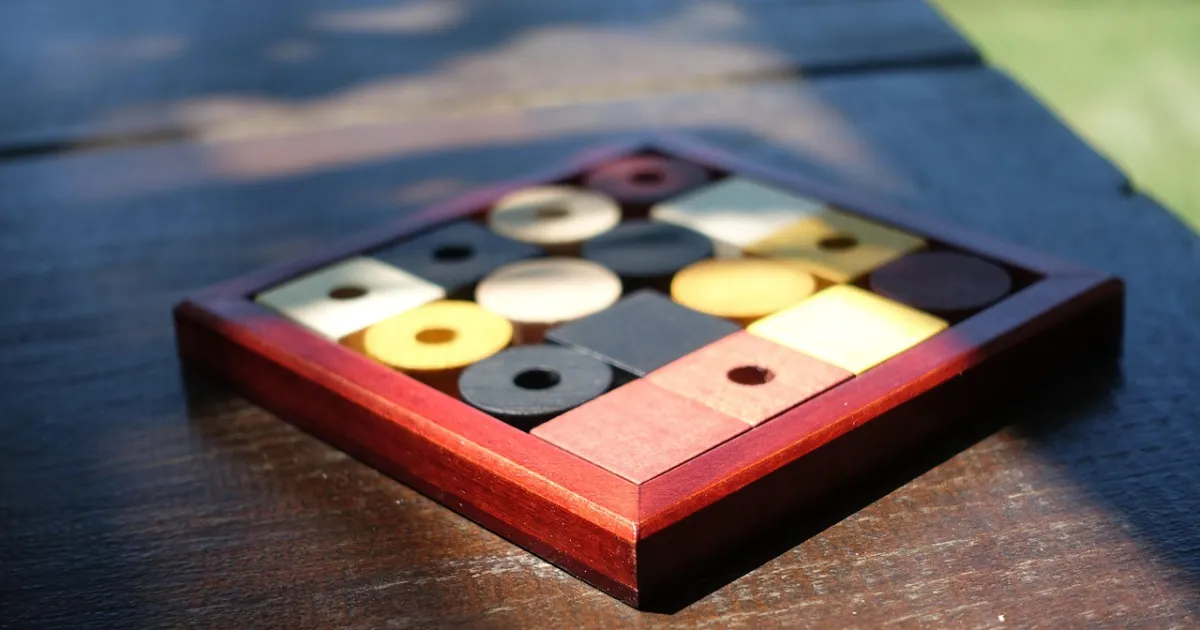
A puzzle box looks like an ordinary box with no visible way in. The lid will not lift, there is no keyhole, and the only way to open it is to find the hidden moves. That mix of mystery and reward is why puzzle boxes are favorite gifts, collector's pieces and the perfect final lock in an escape game.
What is a puzzle box?
Also called a secret box or trick box, a puzzle box can be opened only by solving a puzzle. Some need a single clever move; others need a long series of discoveries, each one unlocking the next. Unlike a padlock, there is usually no code to find: the solution is in how you handle the box.
A short history
Furniture and jewelry boxes with secret compartments have been known since the Renaissance. Boxes made purely for entertainment appeared in Victorian England in the 19th century, and as tourist souvenirs in the Interlaken region of Switzerland and the Hakone region of Japan around the turn of the 20th century. Hakone is also home to yosegi, a traditional marquetry in which strips of different woods form geometric patterns. It is often used to decorate Japanese puzzle boxes, which is why many have that mosaic look. Interest faded around the two World Wars, and craftsmen revived the art in the 1980s. Today artisans around the world make puzzle boxes, from simple souvenirs to intricate collector's pieces.
Common types of puzzle box
| Type | How it opens | Difficulty |
|---|---|---|
| Sliding panel | Panels slide a few millimeters in a set order until the lid is free. The classic Japanese style. | Easy to very hard, depending on the number of moves |
| Hidden button or pin | Press a disguised spot, or tilt the box so a hidden pin drops | Easy to medium |
| Magnetic latch | A magnet held in the right spot pulls a hidden catch | Medium |
| Rotating parts | Turn knobs, rings or the whole lid to the right position | Medium |
| Sequential discovery | Each step reveals a tool, such as a tiny key or rod, needed for the next | Hard |
| Combination box | Dials or letters set to a code, often with a riddle on the lid | Depends on the clue |
Japanese sliding-panel boxes are often described by the number of moves needed to open them. More moves means a longer, harder solve.
How to solve a puzzle box
- Handle it gently. Most mechanisms move with light pressure. If something resists, forcing it can break the box.
- Feel every panel. Push, slide and press each face and edge. A movement of a millimeter or two is often the first step.
- Listen and tilt. A rattle or a click when you turn the box often means a gravity pin or a loose part inside.
- Look for odd details. A knot in the wood, a slightly different color or a decorative stud may be a button.
- Remember your moves. On sliding-panel boxes, note the order. Many must be closed in reverse.
- Take a break. Fresh eyes often spot the move you missed.
Four DIY puzzle boxes
1. The false-bottom box
Cut a piece of card to fit snugly inside a shoebox, place the prize underneath and cover it with tissue paper and a decoy object. Players must realize the box is shallower inside than outside. Add a clue on the lid: "Not everything is as deep as it seems."
2. The magnet drawer
Glue a small steel washer to the back of a cardboard drawer, inside a box with no handle. The only way to pull it out is with a magnet hidden elsewhere in the game. Keep strong magnets away from young children, who can be badly hurt if they swallow them.
3. The sliding lid
Make a wooden or thick-card box with a lid that slides out, and block it with a dowel or pencil pushed through holes in one side. Players must find and pull the pin before the lid moves.
4. The riddle lockbox
Buy a small lockable box with a combination lock and write a riddle or brain teaser on the lid whose answer is the code. It is the easiest to make and the most flexible: change the riddle and you have a new puzzle. Our guide to escape room locks and codes explains which lock types work best.
Using a puzzle box in a game or as a gift
In a home escape game, a puzzle box makes a great final challenge because it feels different from the paper puzzles that come before it. It is also a memorable way to give a small gift: concert tickets, a handwritten note or even a ring. Our escape room proposal ideas use exactly this trick. For a full game built around boxes and clues, see how to make an escape room at home.
Questions
How do you open a puzzle box?
By finding the hidden moves: sliding panels, pressing disguised buttons, tilting the box to release a pin or using a magnet. Each box is different, so feel, listen and look closely.
Are puzzle boxes hard to solve?
They range from boxes that open with one move to collector's boxes that take many steps and hours of play. Look for the number of moves or a difficulty rating before you buy.
What can you put inside a puzzle box?
Gift cards, jewelry, notes, tickets, money for a gift or the final clue of an escape game. Keep items small and light so they do not jam the mechanism.
Can I make a puzzle box at home?
Yes. A false-bottom shoebox, a magnet drawer, a pinned sliding lid or a combination lockbox with a riddle are all simple to build with craft supplies.